
How are sight-loss needs recognised?
Needs can remain hidden when referrals, initial conversations and records do not ask the right questions.
From promise to practice
We identify the specific gap, provide targeted specialist support and help turn recommendations into evidence that people can use in practice.


Start here for free
Answer 15 short questions covering how sight-loss needs are identified, recorded, acted on and reviewed, as well as accessible information, staff practice, risk and leadership oversight.
Receive an immediate result and suggested next step. This is an improvement and qualification tool, not a formal audit, accreditation or compliance guarantee.
Where good intentions break down
The issue is rarely whether staff care. It is whether the organisation can show a consistent route from recognising a sight-loss need to taking action and reviewing the outcome.
Needs can remain hidden when referrals, initial conversations and records do not ask the right questions.
Standard letters, digital forms and verbal-only explanations can prevent informed choice.
Awareness alone does not create reliable communication, guiding or escalation practice.
Over-support can remove independence; under-support can leave avoidable risk unmanaged.
Broad commitments need usable procedures, named owners and records of what changed.
Activity counts are not the same as evidence that a person’s experience or outcome improved.
What stronger support looks like
Ask, record and understand the person’s functional needs.
Give staff procedures and practical options they can use.
Check whether agreed adjustments made a difference.
Show ownership, learning and evidence of improvement.

CQC-relevant evidence
Regulatory methods can change. Your underlying evidence still needs to show how a person’s needs were identified, recorded, acted on and reviewed; how information was made accessible; how staff were supported to respond; and what improved as a result.
Three focused organisation routes
Each route begins with a different real-world problem. Choose the closest fit to jump to targeted support and example outcomes.

Problems you may recognise: sight-loss needs are inconsistently recorded; care plans name the diagnosis but not the functional impact; staff are unsure how to recognise changes in vision or behaviour; reviews do not show whether support worked.
Targeted help:
Example outcome: clearer records, more consistent staff responses and an evidence trail showing how needs were identified, acted on, monitored and reviewed.
See care-provider support options
Problems you may recognise: referral routes or criteria are unclear; inherited waiting lists have no visible risk logic; duty responses vary; assessment and recording standards are inconsistent; audit evidence does not show who owns the next action.
Targeted help:
Example outcome: a clearer service pathway, repeatable practice, risk-led priorities and stronger evidence for audit, commissioning and leadership oversight.
Explore a targeted service review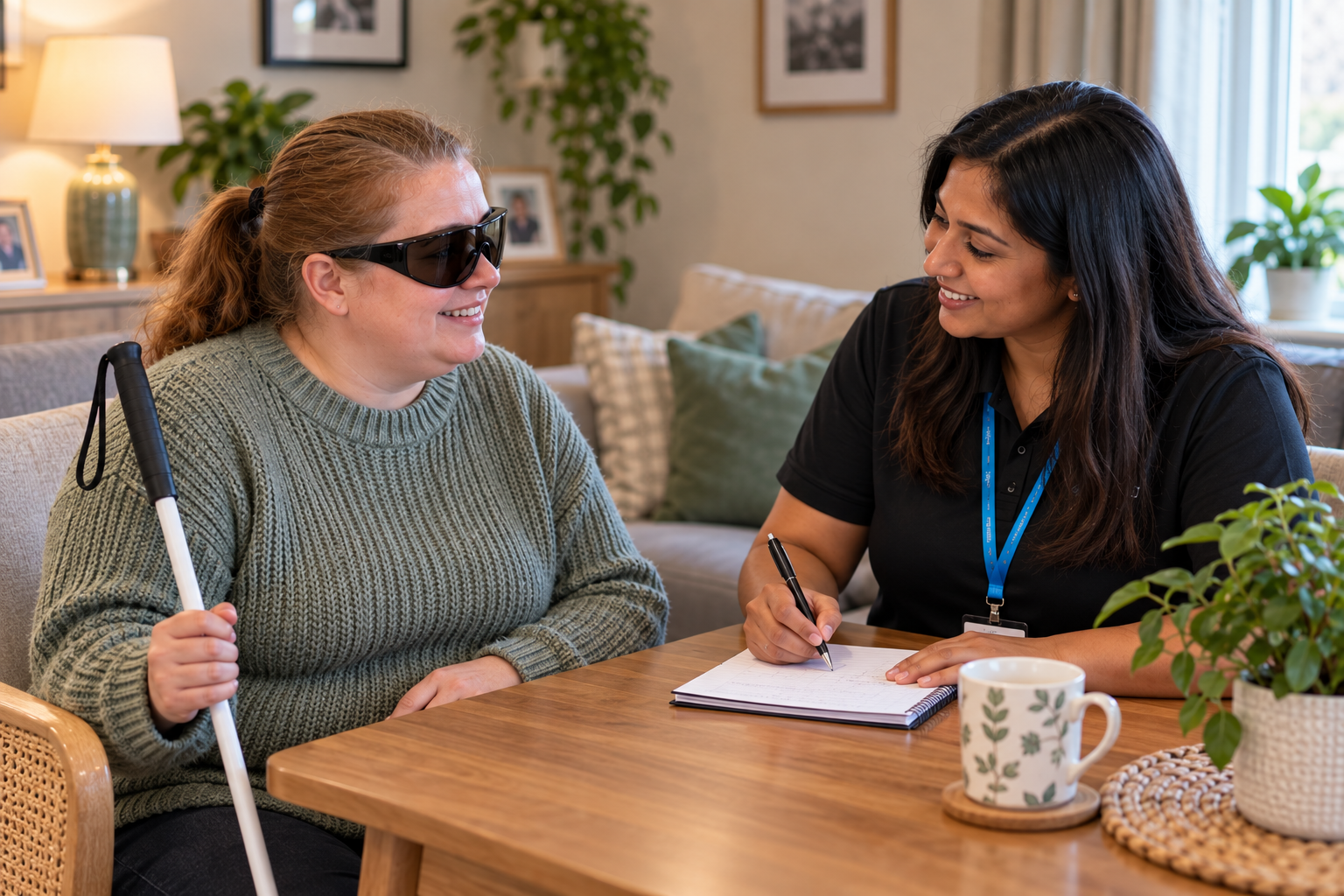
Problems you may recognise: the functional effect of sight loss is unclear; equipment requests are not linked to assessed need; recommendations are scattered; the case needs a proportionate plan with clear professional boundaries.
Targeted help:
Example outcome: a defensible report, prioritised plan and clearer basis for deciding what should be funded, explored or directed to another appropriate service.
Pricing: quoted from the outset around scope, report requirements, professional time, delivery format, travel and expenses.
See insurance and case-management scopeIndividually quoted organisational support
For wider service improvement, we agree the targeted scope first. You know what will be reviewed, what will be delivered and what it will cost before work begins.
Understand the current journey and examine the agreed documents, records and practice.
Compare policy, staff experience and the person’s journey to locate the specific weakness.
Prioritise realistic actions, quick wins, owners and review measures.
Help translate agreed recommendations into documents, processes and everyday practice.
Provide targeted guidance or training where staff knowledge is part of the identified gap.
Professional foundation
A VRS is a Vision Rehabilitation Specialist: a qualified professional who examines how sight loss affects everyday function, independence and safety. The founder is a qualified Senior Vision Rehabilitation Specialist and also brings substantial policing experience in safeguarding, risk assessment, professional reporting, communication, accountability and complex decision-making.
Launching soon · Launch date coming soon
A practical six-pack system designed to help care providers move from recognising sensory needs to consistent everyday practice, staff capability, review and evidence. It brings the key parts of sensory support together rather than treating compliance as a folder of policies.
Start with the person and the system: responsibilities, standards, practical sensory support and the evidence trail.
Recognise possible sight, hearing and dual-sensory difficulties and understand the person's functional needs.
Turn assessment findings into person-centred plans, proportionate risk management and practical everyday action.
Help staff understand what good sensory support looks like and demonstrate that learning is used in practice.
Review whether support works, strengthen oversight and build evidence around real practice and outcomes.
Practical documentation tools to help services put the system into use consistently.
Options and investment
The problems, audience routes and possible outcomes come first. When you are ready to choose a route, these are the current starting points.
Fifteen questions across needs identification, communication, staff practice, risk, records and governance, with a result and suggested next step.
One defined professional VRS question each month, a growing organisation resource library and practical updates when relevant guidance or regulation changes.
£99 per month
Choose organisation membershipOne defined practice, accessibility or documentation question with a focused VRS-reviewed written response. No membership is required.
£125 one-off
Pay for one questionFor a care provider commissioning an otherwise standard sight-loss assessment: 60 to 75 minutes and written recommendations for up to three agreed priority areas.
Individually quoted when the work extends beyond three priority areas, needs extra professional time, involves other services or requires agreed in-person input. “Complex” describes the scope, not the person.
Quoted to scope
Request a quoteInsurance and case-management instructions are not placed into the standard £350 package automatically. The scope and quote first establish the purpose of the assessment, reporting requirements and professional input required.
Would your organisation value a qualified rehabilitation professional you could contact for ongoing questions and specialist input beyond standard membership? Register your interest while the scope and pricing of this possible future service are investigated.
Register retainer interestMeet Judith Gregory, Founder and Director of Sensory Visionaries and a qualified Senior Vision Rehabilitation Specialist. Her professional background combines practical rehabilitation expertise with extensive public-service experience in safeguarding, risk assessment, clear reporting, complex decision-making and accountable problem-solving.
Meet the founderQuestions before you enquire
No. It is a structured improvement tool that highlights where stronger evidence or practice may be needed.
No. Complete the scorecard and receive the result and recommended next step by email. If commissioned work later requires a discussion, that will be agreed as part of scoping.
Potentially. Locations, teams, records and stakeholders are agreed during scoping so the proposal reflects the actual workload.
Yes. Targeted training, document development, implementation support and follow-up review can be included or commissioned as a next phase.
Begin with the evidence

Use the scorecard to find the first gaps. If the result shows a more complex problem, request a structured review.
Take the free scorecard